Posts

Seattle's Victory Gardens

Image
Victory Garden at Seattle Children's Home, 1944. Courtesy MOHAI, Seattle Post-Intelligencer Photograph Collection, 1986.5.7817.3, photo by Ed Watton. From victory gardens to p-patches, Seattle has a long history of community gardening. A straight line links the victory gardens of old with the p-patches, community gardens, and pandemic gardens of today. In particular the idea of vacant land as an untapped resource continues, although such unused plots are harder to find today than they once were. During World War II a cooperative “Victory Garden” was developed in the heart of Seattle’s Ravenna neighborhood, not far from today’s Ravenna Community Center. According to a piece in The Seattle Times , the garden was “serving seven families for a cost of only $3.58 each.” What that amount represented or how it was calculated is not stated. Victory Gardens abounded around the Seattle area, as they did throughout a nation at war. Framed as a way of easing the strain on the country’s agricu...

Farming Revival in the Rainier Valley

Image
"Inch by inch, row by row, someone bless these seeds I sow."  (The Garden Song, David Mallett) Today the landscape of Seattle is dotted with tiny gardens called P-patches, as well as several larger urban farms and orchards. Rainier Valley is no exception; a number of vacant lots and underutilized spaces have been converted to meet the growing desire for freshly-grown produce and the need for food security. Some of these spaces are dedicated to the newer groups of immigrants and refugees who have settled in the valley. The City of Seattle, through its P-patch program, and the Seattle Housing Authority have made concerted efforts to provide gardening space for newcomers. Many of these families come from farming backgrounds and a space to plant and harvest familiar foods is a way to ease the transition to their new home.  Rainier Valley also boasts a demonstration orchard in Hillman City, as well as the Rainier Beach Urban Farm and Wetland, developed on the site of the city’s ol...

What's in a Name? The Kirke Park and P-Patch

Image
Every garden has a story. Tucked into a quiet neighborhood of Ballard is a garden with a particularly unique back story: The Kirke Park and P-Patch.      Remnants Those with a basic understanding of Germanic languages will recognize that the word Kirke means “church.” The park was given a Norwegian name to honor the Scandinavian heritage of the Ballard neighborhood. However, there was a more specific reason for the name: Kirke Park sits on the site of a religious community that once occupied the property for nearly 80 years – not a traditional house of worship as one might find in many neighborhoods, but the residence of a millennialist sect known as the Seventh Elect Church in Israel. Founded in 1922 by a 77-year old preacher, the church dictated chastity, vegetarianism, unshorn hair, and an unquestioning obedience to the authority of its founder, Daniel Salwt. Tall, imposing, with a long-white beard, Salwt ruled over a group of several dozen adherents who handed over ...

Losing Ground: Seattle Lost Patches

Image
Over the course of a half century, Seattle has developed well over 100 p-patch gardens. Not all have survived. Too often, patches have suffered by being labeled “interim use.” The pressures of urban development coupled with rising property values brought down a number of gardens. Other succumbed to social conflict, both external and internal, and other factors. Today we will look at a few of the patches that were forced to close permanently and the circumstances behind the closures. Jackson Place In 1995 the Jackson Place Community Council applied for and received a modest grant from the Department of Neighborhood’s Matching Fund Program to establish a p-patch. The grant application spoke of “the opportunity to beautify our community, take advantage of one of the numerous vacant lots, and have a focus for developing and fostering neighborhood friendships and pride in our community.” The street corner lot was located at 16 th Avenue S. and S. Weller Street on the western slope of the c...

Echoes of Seattle's Garlic Gulch

Image
Our church was Mount Virgin church. We had several Italian grocery stores at Atlantic Street, Italian pharmacy, Italian barbershop. The residents were mainly east and west of Rainier Avenue going all the way up to Beacon Hill. As far south as – oh, a little south of McClellan Street. We had the ballpark. We had the Vacca Brothers farm. And we had the Italian language school here, at Atlantic Street. Thus did baker and businessman Remo Borracchini describe the neighborhood of Seattle’s North Rainier Valley that came to be called Garlic Gulch due to the large number of Italian families settled there. A Garlic Gulch home and garden. Patricelli family. Mary Grace Briglio Patricelli and Michael Patricelli. Courtesy Rainier Valley Historical Society.  Little Italy The main wave of Italian immigrants to Washington’s “shores” came at the turn of the 19th century. Many came to work in the coal mines in South King County; others were farmers who set up truck farms in the Rainier and Duwamish...

Deciphering Garlic Gulch

Image
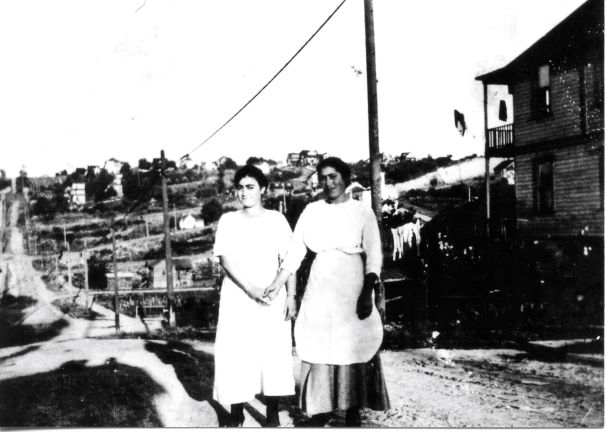
"Gulch" =  a deep or precipitous cleft  :  RAVINE  (Merriam-Webster) Two women in Garlic Gulch, undated. Courtesy Rainier Valley Historical Society (RVHS) The term "Garlic Gulch" is thrown around often to describe the large Italian community that nestled at the north end of the Rainier Valley from the early 1900s until the 1960s and perhaps beyond. But where did the term come from and how was it received? I offer no concrete answers, but a lot of theories and speculation. Did it all start with Big John Croce? I [wonder] if I originated that term, because the reason that it got famous was I had this buddy, a little tiny guy that got drafted in the army. He went to Korea, right? That's a buddy of mine. So when he comes back from Korea the paper, the PI, said we have a veteran Italian kid immigrant returning to Garlic Gulch, his home and so on. And that's where we became famous. (John Croce RVHS Oral History) Croce, founder o...