Posts

Showing posts with the label Interbay P-patch

Crucible for Activism: Fighting for Seattle's Community Gardens
Image
The bulldozers are closin' in now o n my back garden No one can explain why I came to be chosen The bulldozers are closin' in They've ripped up all the trees Soon the lorries will be zooming through me  cabbages and peas (The Motorway Song, Black Family) Seattle's p-patchers and community gardeners have often witnessed bulldozers closing in, both metaphorically and in reality. Threats to these edens, external and internal, have served to push those engaged in peaceful pursuits to take action, organize, fundraise, and learn to work together for common goals. Here are some of the stories: Bradner Gardens: Protecting Parks Bradner Gardens was originally set up by the City of Seattle to provide space for Mien refugees from Laos in the 1980s. A few years later, the Mount Baker garden overcame a serious threat. Long-time gardener and activist Joyce Moty described how the neighborhood banded together to protest the city’s decision to sell the land to a housing developer in the...

What lies beneath? The layered history of Seattle's community gardens

Image
Sundial at Bradner Gardens Park. An old landfill, an abandoned airstrip, reclaimed wetlands, a public utility right-of-way, the top of a parking garage! All these are bits of the urban landscape repurposed for the growing of fruits, vegetables, and flowers. One of the fascinating aspects of Seattle's community gardens is the variety of landscapes adapted for their use. Whether "interim" use or permanent, the gardens and p-patches have managed to find homes in odd and interesting places. In its own way, the story of locating gardens is one of waste not, want not. Dumping grounds Several p-patches have found a home on old dump sites. Dumps, both sanctioned and not, have typically been sited on undesirable land -- low-lying and perhaps swampy ground that is unsuitable for building. Such was the huge municipal dump and later landfill at Interbay, as well as the Montlake landfill, the latter on land reclaimed after the lowering of Lake Washington in 1916. Today the Interbay P-...

How do you move a garden? Part three: The Interbay P-Patch

Image
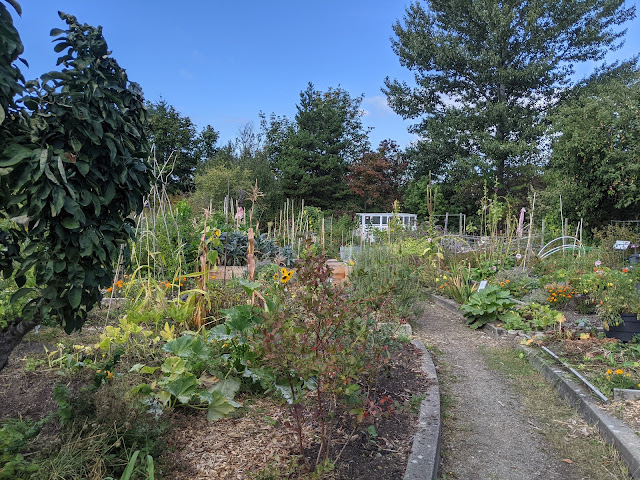
"You don't just inherit dirt here, you inherit the past, whoever was there planting things." -- Donna Kalka, gardener Sandwiched between 15th Avenue NW and the railroad tracks, in the cleft between the Queen Anne and Magnolia hills, lies a sort-of no man's land. Part tide lands, part low-lying swale, the Interbay area has been used for everything from a dump to a parking lot, to railroad yards and light industry, to athletic fields and golf courses. And a P-Patch. The Interbay P-Patch was founded in 1974, just one year after the start of the city's P-Patch program. In point of fact, informal gardening may have been going on for some time on the little-used acres prior to the official opening. Some 47 acres of property were (and are) managed by the Seattle Parks Department; the P-Patch, on one acre at the heart of the site, was surrounded by athletic fields and a golf course. Squeezed on all sides, it was just a matter of time before, like Sand Point and Eastlake ...